Advanced Manufacturing
ISSN: 2959-3263 (Print)
ISSN: 2959-3271 (Online)
CODEN: AMDAE3
CiteScore 2025: 1.1
A systematic review of machine learning approaches for phase stability and mechanical property prediction in high-entropy alloys
High entropy alloys (HEAs) have attracted significant research interest owing to their vast compositional space and diverse achievable properties. However, exploring this extensive design space and experimentally determining phase constituents and mechanical properties are time-consuming processes. Machine learning (ML) provides a data-driven approach to identifying relationships among alloy composition, phase, microstructure, and mechanical properties. This review was conducted in accordance with Preferred Reporting Items for Systematic Reviews and Meta-Analyses (PRISMA) guidelines. A systematic Web of Science search identified 301 records; 58 studies were selected for detailed analysis after screening. The review examined various ML models and datasets for predicting the HEA phase and mechanical properties. Most ML models have been developed to study conventional HEAs composed of Al, Co, Cu, Fe, Ni, and Mn, whereas lightweight, refractory, eutectic, and other novel HEAs remain underexplored. Prediction performance depends not only on the ML model but also on dataset size and diversity, input parameters, and target properties. Future studies should focus on developing larger, more compositionally diverse datasets, adopting transparent methods, and integrating ML models with experimental verification to improve the reliability and transferability of HEA design.

Artificial intelligence in additive and smart manufacturing: a critical review of design, process optimization, and quality control
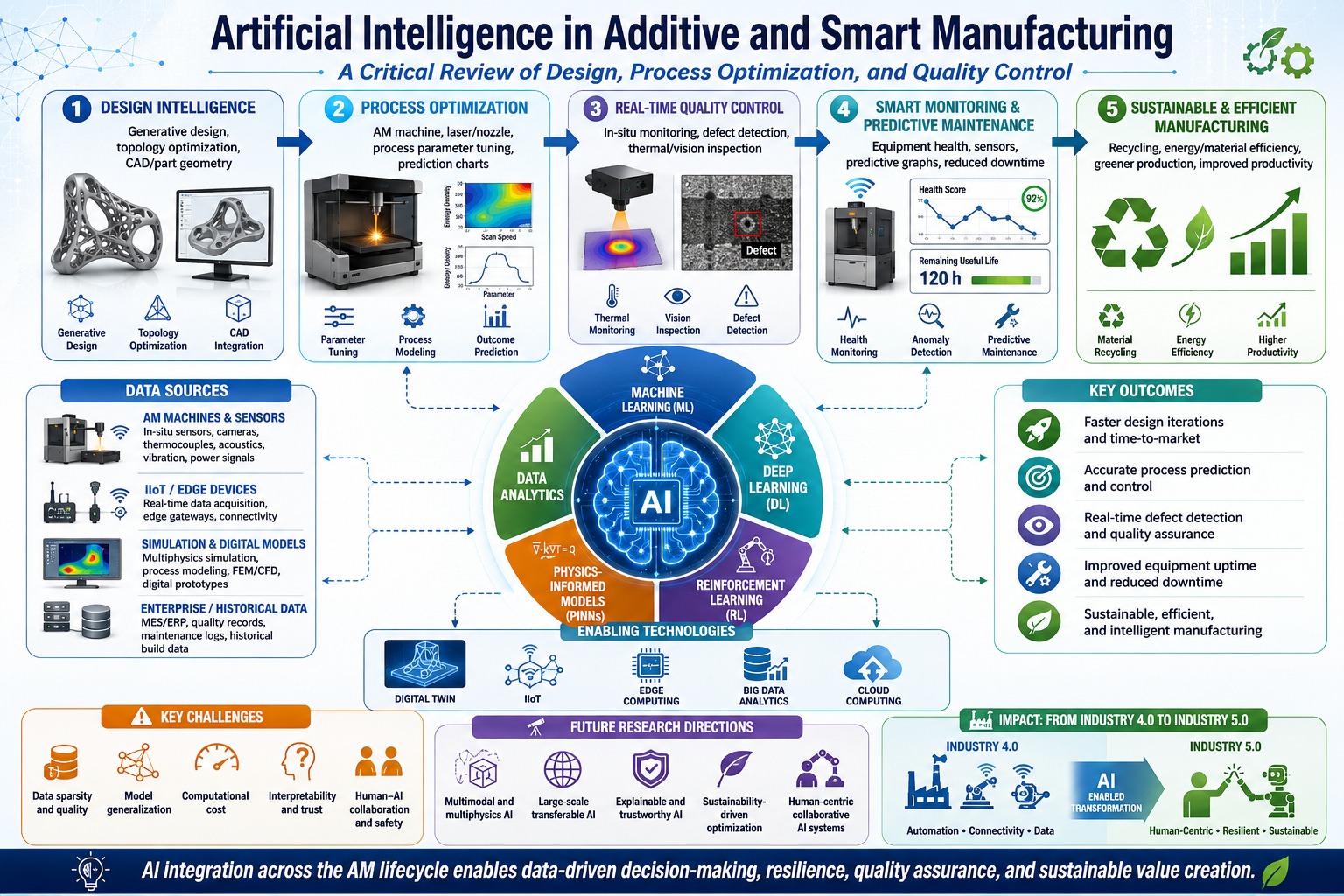
The rapid adoption of artificial intelligence (AI) in the production sector has triggered a revolutionary change in the design, manufacturing, monitoring, and optimization. The paper is a critical analysis of AI-based additive manufacturing (AM) and smart manufacturing systems with an emphasis on design intelligence and process optimization, real-time quality control, and sustainable production. Based on recent literature, this paper considers the major AI methods, such as machine learning (ML), deep learning (DL), reinforcement learning (RL), and physics-informed neural networks (PINNs) throughout the manufacturing lifecycle. The results show that AI can greatly decrease the time spent on design iterations, increase the accuracy of predictions of process parameters, and allow in-situ defect detection with high accuracy. Moreover, AI helps to ensure predictive maintenance strategies, reduce the number of unforeseen failures and enhance operational efficiency. The interplay of AI and digital twin technology, Industrial Internet of Things (IIoT), edge computing, and big data analytics is cited as a pillar of Industry 4.0 and the future Industry 5.0 paradigm. Regardless of these developments, the issues of data sparsity, the applicability of the model, computational expense, and interpretability are the key obstacles to large-scale industrial adoption. The value of human-AI cooperation and the necessity to have explainable and reliable AI systems in critical safety areas are also emphasized in the study. Lastly, the review provides future research directions, which focus on multi-modal AI, large-scale manufacturing models, and sustainability-based optimization frameworks. In general, the article is a thorough synthesis of the recent developments and realistic directions of introducing AI-enabled smart manufacturing.
Rotary ultrasonic machining of single-crystal silicon
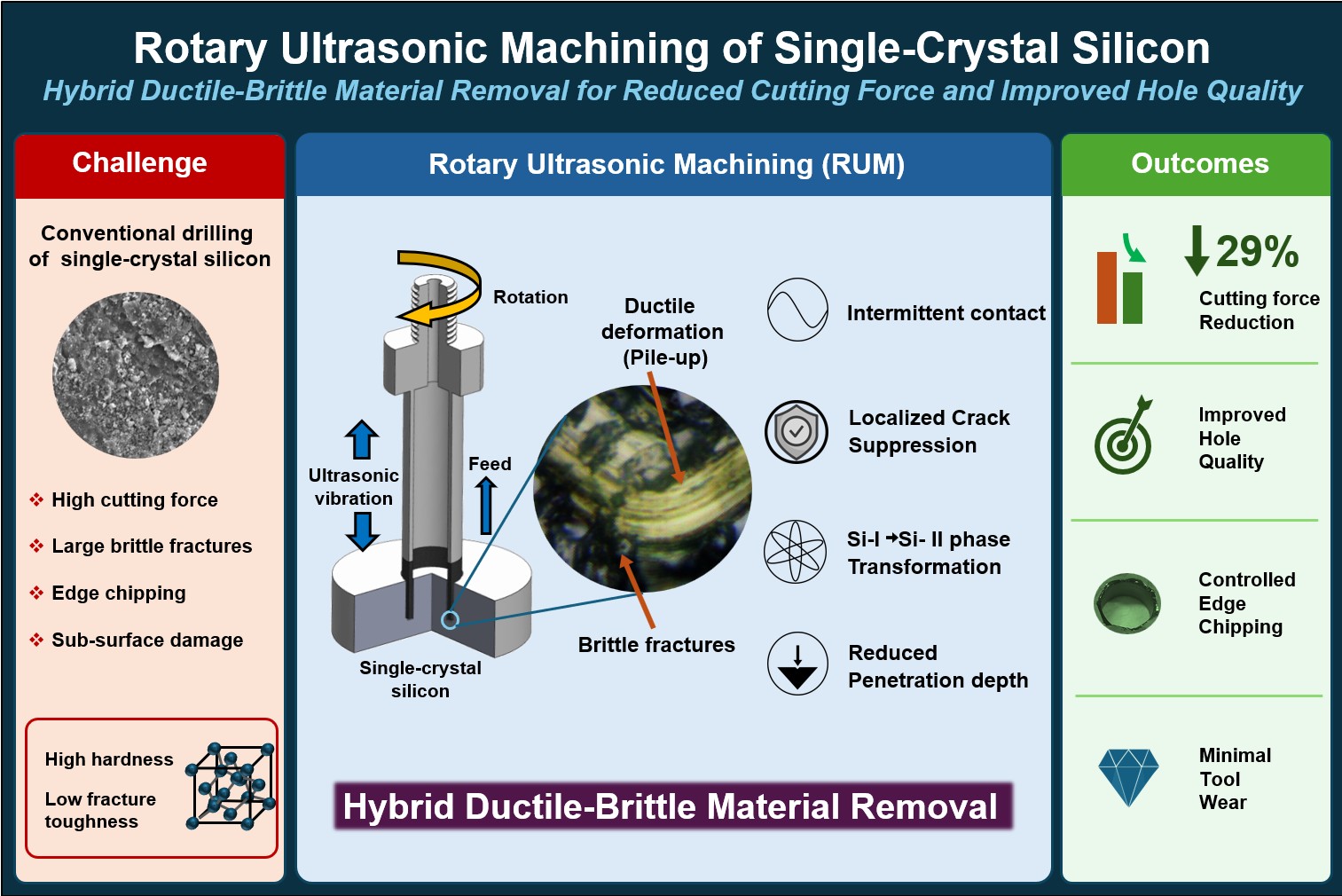
Precision machining of single-crystal silicon components presents critical challenges for the semiconductor and photovoltaic industries due to its high hardness and low fracture toughness. Conventional machining processes are often susceptible to workpiece breakage and subsurface damage, along with high tool wear and poor surface finish. Recent studies have increasingly focused on achieving ductile mode machining of single-crystal silicon using nontraditional machining processes; yet studies on the material removal mechanism remain limited. In this study, the feasibility of rotary ultrasonic machining (RUM) of single-crystal silicon and the material removal mechanism were investigated. The material removal mechanism study via microscopic imaging, motion simulation, and nanoindentation experiments revealed that RUM promoted localized ductile deformation during silicon machining, resulting in a hybrid ductile-brittle material removal mode. The effects of input variables (feedrate, spindle speed, and ultrasonic power) on cutting force, surface roughness, geometrical accuracy of the machined holes, and edge chipping sizes were also evaluated. The results showed that ultrasonic vibration assistance effectively reduced cutting force, while hole quality improvement and edge chipping mitigation were achieved through appropriate selection of machining parameters. Compared with conventional machining conditions, tool wear was also minimal during RUM.