
Neuroelectronics
ISSN: 3006-1032 (Print)
ISSN: 3006-1040 (Online)
CODEN: NEURV5
Band-specific EEG connectivity and graph-theoretical features for attention detection
Electroencephalogram based attention detection becomes growing research filed in past years because his enormous application from education to clinical diagnosis. Exiting approaches to detect attention has often relied on features extracted from individual electrodes, such as frequency or entropy measures. In this study we examined graph-theoretical features derived from Coherence, Pearson correlation, and Mutual Information across theta, alpha, beta, and broadband bands in ten participants. Nine graph features capturing network integration and hub centrality were extracted per epoch, and false discovery rate correction identified 6 significant features in both theta, alpha bands and 9 in beta band, with notable effect sizes (Cohen’s d = 0.88–1.70). Theta networks showed small-world-like topology during Attention, alpha networks were more segregated during Inattention, and beta networks exhibited the richest differences. Subject-dependent classification reached 97.23% accuracy (Mutual information, Logistic Regression, beta band; F1-score = 0.970, Area under curve = 0.998), while leave one subject out confirmed broadband MI features as the most consistent (87.91% ± 6.34%; F1 = 0.893, AUC = 0.927), though higher inter-subject variability highlights instability was noted, which is expected in this small group of subjects. These results suggest that combining linear and information-theoretic connectivity measures captures complementary aspects of attentional networks, with broadband MI features outperforming traditional electrode-level approaches and offering a promising approach for EEG-based cognitive monitoring.

Lossy compression with feature reduction preserves motor decoding for brain-computer interfaces
Implantable neural prosthetic systems must transmit multichannel peripheral nerve recordings under strict power and wireless bandwidth constraints. This study evaluates a compression based feature reduction (CBFR) pipeline that couples transform domain lossy compression with post-compression feature reduction to preserve motor decoding while reducing data rate. After preprocessing, signals are compressed using Sym4/Haar the discrete wavelet transform (DWT), the discrete cosine transform (DCT), or the Walsh–Hadamard transform (WHT) with coefficient soft-thresholding, reconstructed, and used to compute 14 time-domain features. CBFR then computes feature-wise normalized root mean square error (NRMSE) relative to the preprocessed baseline and discards features that are insufficiently preserved before training a GRU classifier. On invasive recordings, CBFR achieves up to 11.29× compression while keeping accuracy about 11% above baseline. On non-invasive recordings, compression ratios up to 21.08× are obtained while accuracy remains about 5% above baseline. DCT provides consistently strong balanced accuracy and compression results, whereas WHT produces higher compression with greater variability. All evaluations are performed in software on recorded datasets, and end-to-end on-device benchmarking and direct comparisons to learned compressors remain future work.

Latest advances in neurointerface-based electrical stimulation for spinal cord injury: a review
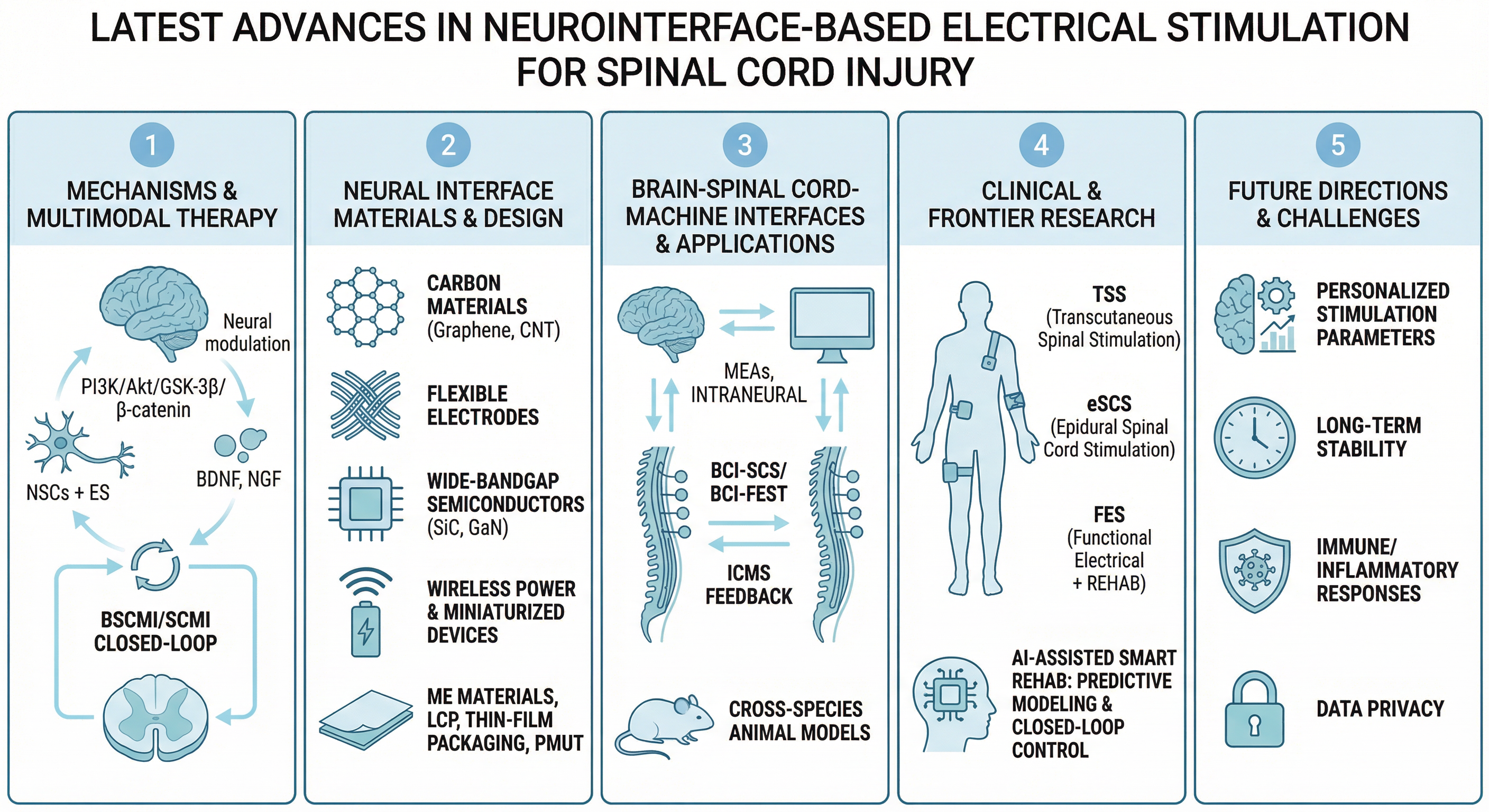
Spinal cord injury (SCI) causes severe damage to neural pathways, leading to substantial motor and sensory deficits that drastically reduce patients’ quality of life. In recent years, electrical stimulation technologies rooted in neurointerface research have gained attention as innovative approaches to encourage neural repair and functional recovery after SCI. This article offers a detailed examination of the most recent advancements in electrical stimulation for SCI, focusing on three key areas: multimodal neuromodulation methods, novel neurointerface materials and designs, and the development of wireless and miniaturized neural stimulation devices. A special focus is placed on brain-spinal cord-machine interface (BSCMI) systems, which aim to re-establish communication between the brain and spinal circuits. The review also examines the underlying mechanisms through which electrical stimulation promotes neural plasticity and aids in functional restoration. Notably, it highlights the growing integration of electrical stimulation with other therapies, including neural stem cell transplantation, intelligent rehabilitation techniques, and AI-driven personalized treatment plans. Despite these promising developments, several technical hurdles remain. The article concludes by discussing these challenges and outlining future research directions, with the goal of offering valuable insights for clinical practice and improving outcomes for individuals with SCI. Ultimately, this analysis emphasizes the significant potential of neurointerface-based electrical stimulation in transforming SCI treatment and enhancing patient recovery.