Renewable and Sustainable Energy
ISSN: 2959-0760 (Print)
ISSN: 2959-0779 (Online)
CODEN: RSEEC9
From prediction to optimization: digital and hybrid approaches for sustainable energy systems
The transition toward sustainable energy systems is no longer defined only by the deployment of renewable technologies. It is increasingly shaped by our ability to manage complexity. As renewable generation expands across power systems, buildings, and distributed energy infrastructures, the central challenge is not simply producing clean energy, but using it more intelligently, more efficiently, and more flexibly.
Low-frequency energy harvesting using a counterweighted pendulum for maritime applications
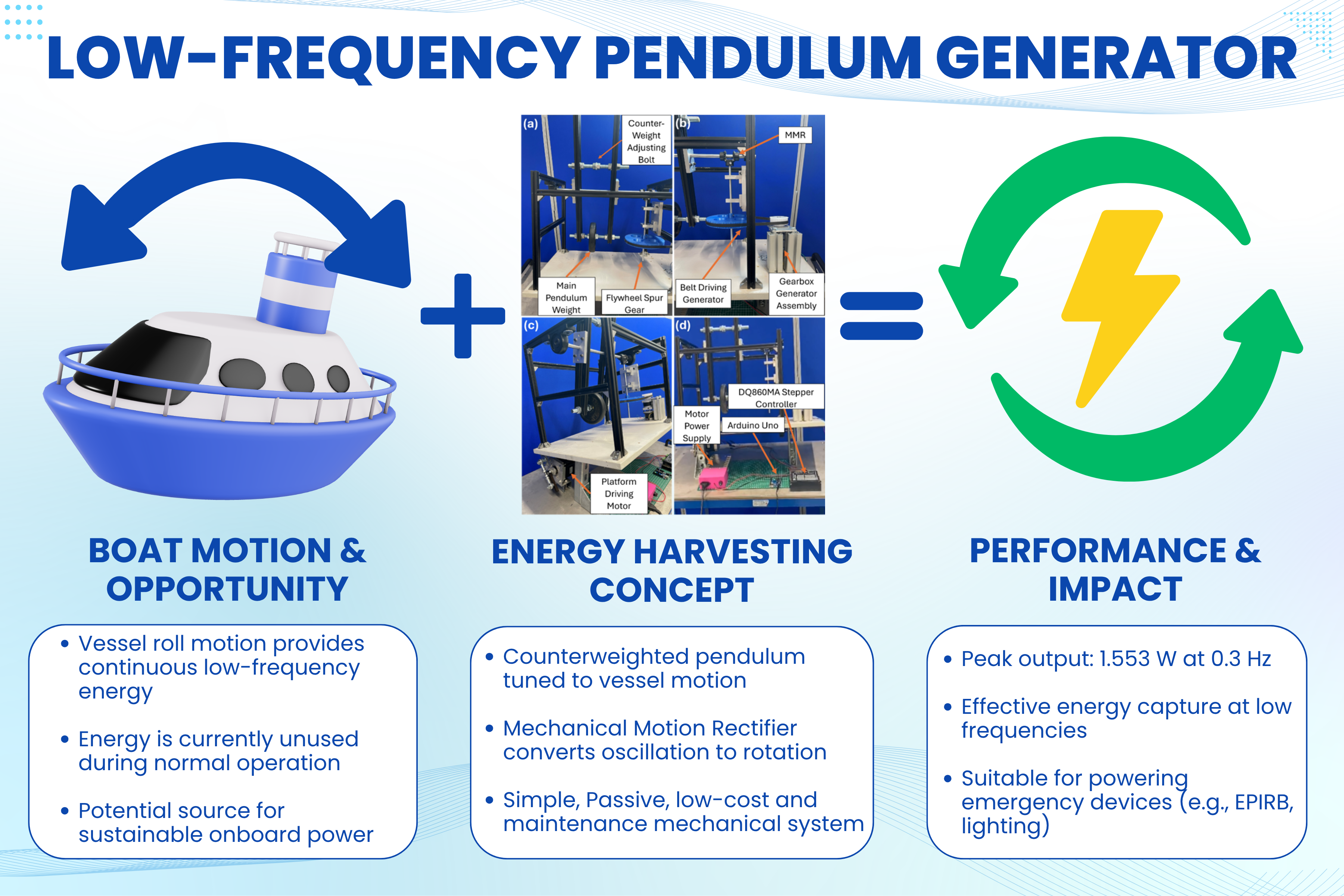
This paper presents the design, development, and experimental evaluation of a low-frequency energy harvesting device based on a counterweighted pendulum system. Targeting maritime applications, particularly as an emergency power source for lighting or homing beacons, the device converts mechanical oscillations into electrical energy using a stepper motor, a mechanical motion rectifier, and a flywheel. A key focus is tuning the system for resonance at low excitation frequencies typical of marine environments. Through a series of controlled tests, the system achieved a peak average power output of 1.553 W at 0.3 Hz using a 3.049 kg pendulum at a 25 cm length. Comparative analysis highlights the efficiency gains from tuning pendulum length, mass, and counterweight placement. The device architecture emphasizes low-maintenance operation, passive actuation, and the use of manufacturable, modular components suitable for scalable production and integration into maritime or industrial platforms. These attributes position the system as a sustainable energy-harvesting solution that can complement hybrid power architectures and contribute to circular manufacturing approaches by reducing reliance on disposable batteries in remote systems. The results demonstrate significant improvements over similar harvesting technologies operating at higher frequencies and lay the groundwork for broader deployment in resilient, sustainable marine systems.
Hybrid Ivy growth optimization and BP neural network model for accurate of building energy efficiency
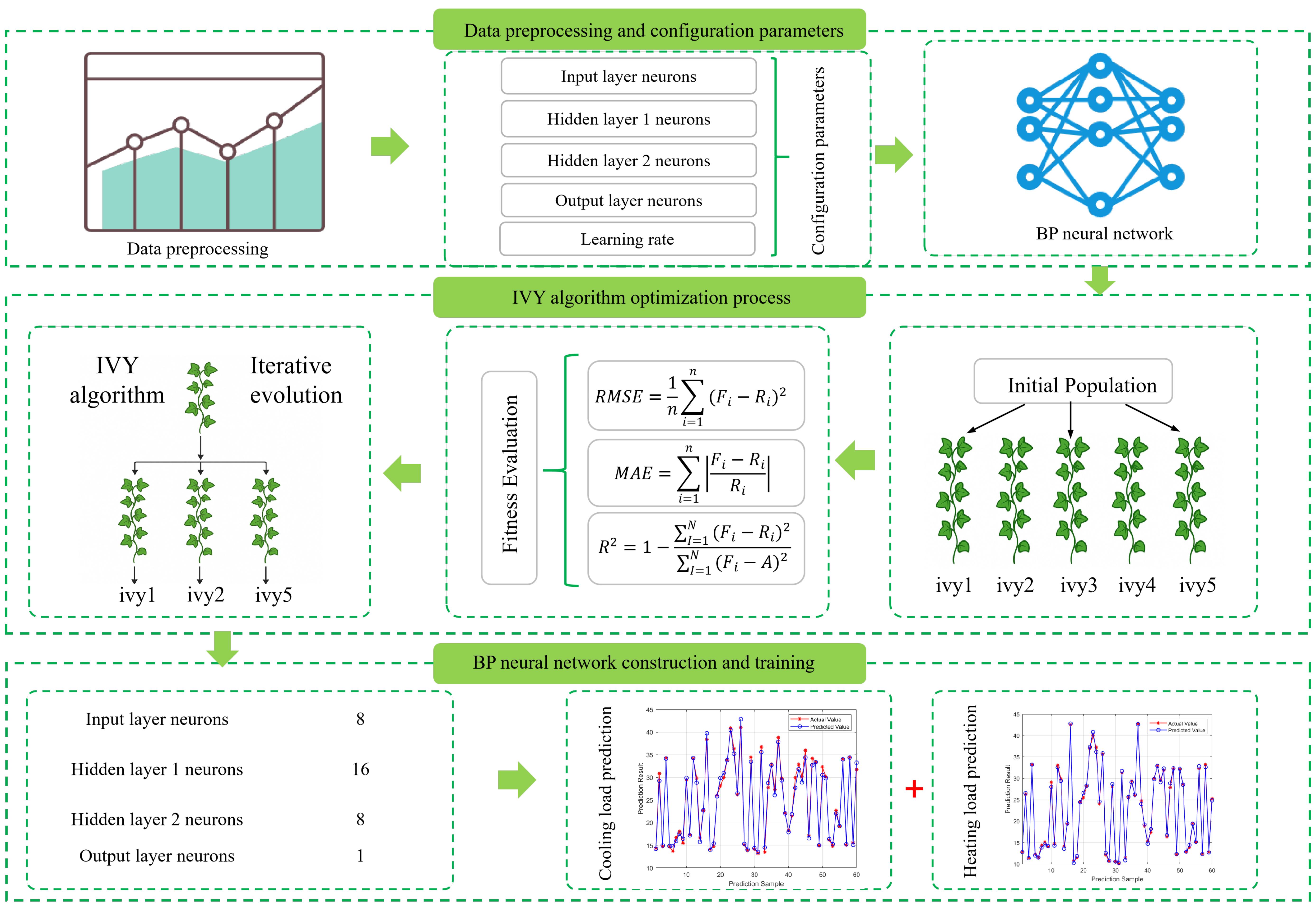
Accurate prediction of building energy consumption is crucial for optimizing energy efficiency and reducing carbon emissions. Although the Backpropagation (BP) neural network is widely adopted for its strong nonlinear mapping capability in modeling complex architectural-energy relationships, it often suffers from slow convergence and a tendency to become trapped in local minima. To address these limitations, this study proposes a novel hybrid forecasting framework, IVY-BP, which integrates the Ivy Growth Optimization (IVY) algorithm with a BP network. The model utilizes architectural features as inputs to precisely predict two key outputs: Heating Load (HL) and Cooling Load (CL). Specifically, the IVY algorithm is employed to globally optimize the initial weights and thresholds of the BP network, significantly enhancing its robustness. Utilizing the UCI Energy Efficiency dataset, the model’s performance was rigorously evaluated against benchmarks including CNN, RF, ELM, and GA-BP. Experimental results demonstrate that IVY-BP achieves superior accuracy, with R2 values reaching 0.9976 for HL and 0.9902 for CL, while maintaining the lowest MAE and RMSE. In conclusion, the proposed IVY-BP model provides a precise tool for smart building management systems, enabling intelligent regulation of HVAC systems to achieve sustainable energy goals.